
INVESTMENT
Lombok vs Bali: Where Should You Invest in 2026?
Everyone who looks at Indonesian real estate eventually asks the same question: Bali or Lombok?
Updated
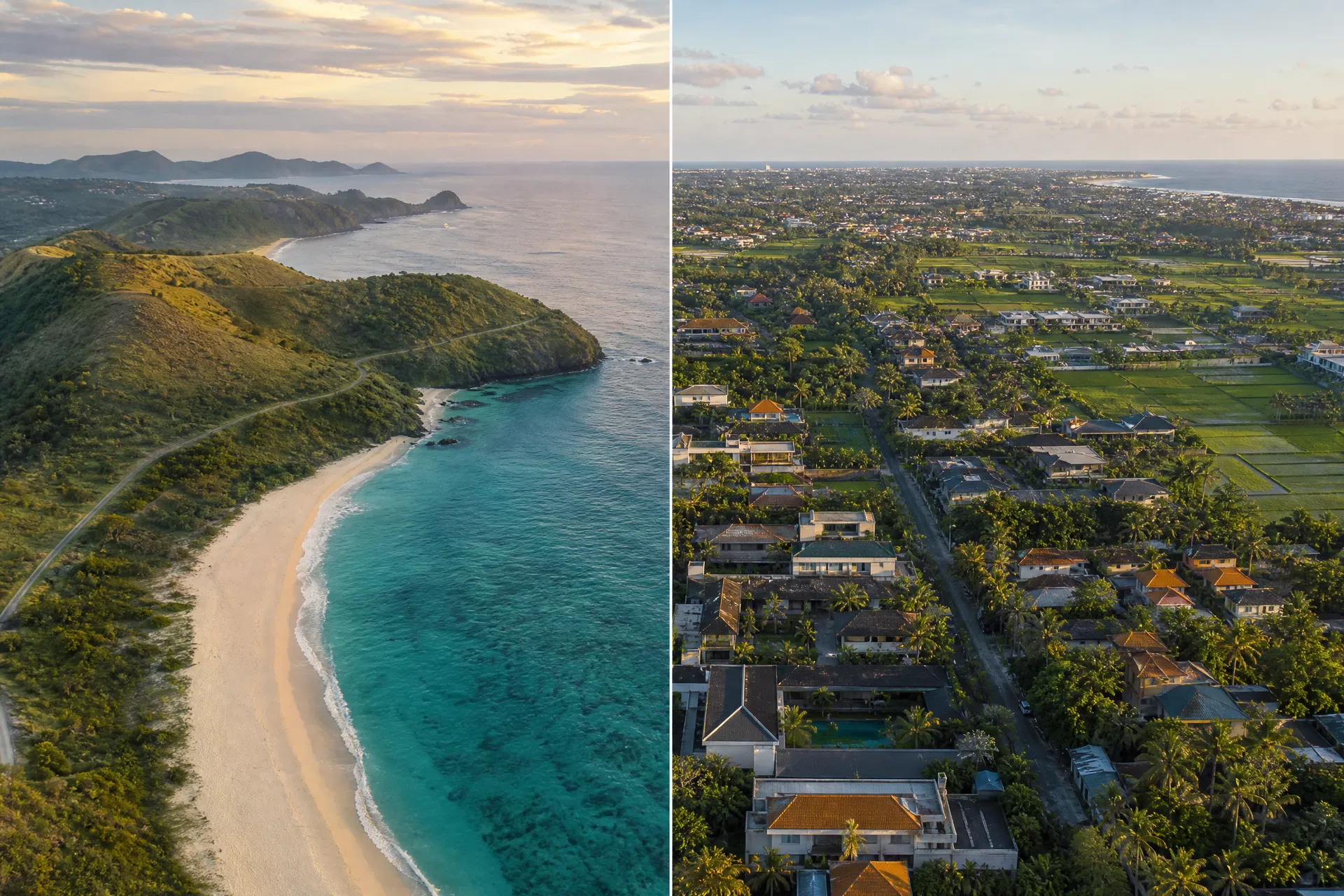
Lombok vs Bali: Where Should You Invest in 2026?
Published by SAN BADA DEVELOPMENT · Kuta Lombok, South Lombok
Everyone who looks at Indonesian real estate eventually asks the same question: Bali or Lombok?
Bali has the brand recognition, the infrastructure, and the track record. Lombok has the land availability, the growth momentum, and the price advantage. Neither answer is universally correct — but the right answer for you depends on what you're trying to achieve, how much capital you're deploying, and how much risk you're willing to carry.
This guide breaks down both markets across the factors that actually matter for foreign investors: entry cost, rental yield, capital appreciation, legal structure, and execution risk. We give you the data, not the sales pitch.
The Headline Numbers
Here is a side-by-side comparison of the two markets as of mid-2026:
| Factor | Bali | Lombok |
|---|---|---|
| Entry price (mid-range 2BR villa) | USD 250,000 – 500,000 | USD 100,000 – 280,000 |
| Land price — prime areas | IDR 1–5 billion/are (USD 60k–345k) | IDR 75M–500M/are (USD 5k–35k) |
| Construction cost | USD 600 – 1,200/m² | USD 650 – 1,500/m² (IDR 10–22M/m²) |
| Gross rental yield (STR, managed) | 8 – 14% | 13 – 22% |
| Net rental yield (after costs) | 5 – 10% | 8 – 14% |
| Occupancy (2025 peak, Bali) | 64.7% (July 2025) | 55 – 75% (location-dependent) |
| Land price appreciation (2024–2025) | 3 – 8% | 15 – 24% (beachfront/hilltop) |
| Total tourist arrivals (2025) | ~33.6 million (7.05M intl + 26.6M domestic) | ~2.5 million (est., intl + domestic) |
| Airbnb/STR listings | 39,000+ | ~4,500 |
| Market stage | Mature / consolidating | Early growth |
Sources: Investland Bali / Reid Real Info 2025 Market Report, Kinnara Asia June 2026, Kingswood Bali Villas, South Lombok Land Sales, BPS Bali 2025, NTB Provincial Tourism Office
Entry Cost: Lombok Wins on Affordability — But the Gap Is More Nuanced Than You Think
The most immediate difference between the two markets is the cost of entry. In Bali's prime corridors — Canggu, Seminyak, Uluwatu — land now trades at IDR 1 to 5 billion per are (roughly USD 60,000 to USD 345,000 per are). A two-bedroom villa in a desirable Canggu or Seminyak location starts at USD 247,000 and quickly climbs past USD 500,000 for anything with a pool and quality finishes.
Lombok tells a different story — but it is not a single story. The island has a wide range of land prices depending on location, access, and proximity to the beach:
- East Lombok beachfront (emerging areas): IDR 75–100 million/are (USD 5,000–7,000) — some of the most affordable coastal land in Indonesia
- South Lombok inland / Selong Belanak area: IDR 100–200 million/are
- Kuta Lombok (standard plots, 500m+ from beach): IDR 150–250 million/are
- Kuta Lombok (beachfront / prime Mandalika-adjacent): IDR 300–500 million/are — premium plots in the most established tourist corridor now command prices comparable to Bali's emerging areas
That last point is worth emphasising. The narrative that "Lombok is cheap" is increasingly outdated for the best-located plots in Kuta. Prime beachfront land at IDR 400–500 million per are is real, and investors who expect Bali-era 2015 prices in Kuta will be disappointed. The value proposition in Lombok is not that everything is cheap — it is that the growth runway is longer and the supply of quality product is still limited.
For investors working with USD 150,000 to 350,000, a completed villa in South Lombok remains achievable. For those with USD 500,000 or more, the choice between the two islands becomes genuinely nuanced.
Construction Cost: A Correction to a Common Misconception
One of the most persistent myths about Lombok is that construction is significantly cheaper than Bali. The reality in 2026 is more complicated.
Bali construction costs (per sqm, Kingswood Bali Villas 2026 data):
| Quality Tier | Cost per sqm (USD) |
|---|---|
| Standard | USD 600 – 650 |
| Mid-range | USD 650 – 850 |
| Premium | USD 850 – 1,200 |
| Ultra-luxury | USD 1,200+ |
Lombok construction costs (per sqm, Kingswood Bali Villas 2026 data):
| Quality Tier | Cost (IDR/sqm) | Approx. USD/sqm |
|---|---|---|
| Medium quality | IDR 10–14 million | USD 620 – 870 |
| Luxury / resort-grade | IDR 15–22+ million | USD 930 – 1,370+ |
The overlap is significant. A mid-range villa in Lombok costs roughly the same per square metre as a comparable build in Bali. Where Lombok retains a cost advantage is at the standard tier — basic investment-grade construction can still be executed more economically than in Bali's labour-constrained market. But if you are building to a quality that attracts premium short-term rental guests, do not budget on the assumption that Lombok will be 30–40 percent cheaper than Bali. The gap has narrowed considerably as skilled labour and quality materials have become more sought-after across the island.
The real cost advantage in Lombok is in land, not construction.
Rental Yield: Lombok Has the Structural Edge — With Important Caveats
Gross rental yields in Lombok currently range from 13 to 22 percent for well-located, well-managed villas. Bali's mature market delivers 8 to 14 percent gross in prime areas, translating to 5 to 10 percent net after management fees (15–25% of gross revenue), platform commissions, maintenance, and tax.
Bali's 2025 rental data is instructive. Occupancy peaked at 64.7 percent in July 2025 — every month of 2025 outperformed 2024. Average daily rates across the island ranged from USD 74 to USD 160 for one- and two-bedroom villas depending on area, with Uluwatu and Canggu commanding the highest rates. However, total rental revenue across Bali declined from 2024's USD 132–155 million monthly to USD 112–115 million in Q3 2025 — operators are prioritising occupancy volume over rate increases in an increasingly competitive market.
Lombok's rental market is structurally different. With roughly 4,500 short-term rental listings versus Bali's 39,000+, and tourist arrivals growing at approximately 15 percent annually, the supply/demand ratio strongly favours landlords. An undersupplied rental market with rising demand is the textbook condition for strong yields.
The caveat is occupancy depth. Bali's rental market is deep and liquid — a well-marketed villa in Canggu or Uluwatu can achieve 60–75 percent occupancy year-round. Lombok's market is thinner, and occupancy rates are more variable, typically ranging from 55 to 75 percent depending on season and location. A villa that achieves 18 percent gross yield at 70 percent occupancy is an excellent investment. The same villa at 40 percent occupancy is not.
Management quality and marketing are therefore more critical in Lombok than in Bali. The market rewards good operators and punishes passive ones.
Capital Appreciation: Lombok Is the Growth Story
Land price appreciation tells you where the smart money is going. South Lombok real estate projections from multiple sources point to 15–24 percent price growth in beachfront and hilltop areas through 2026, driven by infrastructure momentum. Bali's prime corridors are delivering 3–8 percent appreciation in the current consolidation phase — meaningful, but a fraction of Lombok's trajectory.
Several structural factors are driving Lombok's appreciation:
Infrastructure investment. The Mandalika Special Economic Zone (KEK Mandalika) has attracted IDR 5.73 trillion in realised investment, with an additional USD 248 million loan from the Asian Infrastructure Investment Bank (AIIB) committed to road, water, and utility upgrades across South Lombok.
Airport and connectivity. Lombok International Airport continues expanding international routes. Scoot added Singapore–Lombok capacity in 2025, and TransNusa launched Bali–Lombok services. The Gili Mas Cruise Port now connects directly with Bali. More direct international access is the single biggest driver of villa rental demand.
MotoGP and international events. The annual MotoGP circuit at Mandalika brings a concentrated surge of international visitors and media exposure that no amount of marketing spend could replicate.
Supply constraint. In late 2025, Bali's Governor announced construction restrictions on new villas in several districts, citing overdevelopment. Lombok has no such constraint — but it also has far less supply, which means the window for early-mover advantage remains open.
Bali's appreciation story is largely written. The island has been a premier destination for decades, and while values continue to grow, the outsized gains belong to investors who entered five or ten years ago. Lombok's appreciation story is still in its early chapters.
Legal Structure: Comparable, With Local Nuance
Both islands operate under Indonesian national law, so the legal framework for foreign ownership is identical in principle. Foreigners cannot hold freehold (Hak Milik) title directly. The two practical structures are:
Leasehold (Hak Sewa / Hak Pakai): A long-term lease — typically 25 years with a 25-year extension option — is the most common structure for foreign villa investors. It is straightforward, relatively low-cost to establish, and legally sound when documented correctly. The key risk is title quality: you must verify that the underlying freehold is clean and unencumbered before signing.
PT PMA (Foreign-Owned Company): Establishing an Indonesian foreign investment company allows you to hold Hak Guna Bangunan (HGB) title, which is a stronger ownership right than leasehold. It involves higher setup costs (USD 3,000 to 8,000) and ongoing compliance obligations, but provides greater legal certainty for larger investments or development projects.
The practical difference between Bali and Lombok on this dimension is not the law — it is the local ecosystem. Bali has a mature network of notaries, property lawyers, and due diligence firms who handle foreign transactions routinely. Lombok's ecosystem is developing. Competent professionals exist, but they are fewer, and the risk of encountering unqualified or unscrupulous intermediaries is higher.
This is one of the most important reasons why working with a licensed, established local entity matters more in Lombok than in Bali.
Execution Risk: The Factor Most Investors Underestimate
Both markets carry execution risk — the risk that your project is not delivered on time, on budget, or to the quality you expected. But the risk profile differs significantly.
In Bali, the construction industry is mature. There are hundreds of experienced contractors, established supply chains, and a large pool of qualified architects and project managers. The primary risk is not absence of competence — it is price inflation and competition for skilled labour in an overheated market.
In Lombok, the construction industry is younger. Experienced, licensed contractors exist, but they are outnumbered by informal operators who lack the systems, financial management, and accountability structures to deliver complex projects reliably. The most common failure modes are advance payment fraud (contractors who take a deposit and disappear or stall), material substitution (using cheaper materials than specified), and scope creep without documentation.
For foreign investors, execution risk in Lombok is compounded by distance and legal recourse. If a contractor defaults, pursuing recovery through Indonesian courts is slow, expensive, and uncertain — particularly for foreigners who lack local relationships and language capability. Language barriers, legal costs, and the practical difficulty of enforcing judgements against individuals mean that prevention is the only realistic strategy. Recovery after the fact is rarely successful.
The mitigation is straightforward: work with a licensed Indonesian legal entity that has a verifiable track record, a transparent contract structure, and accountability to Indonesian commercial law. This is not a sales point — it is the single most important risk management decision you will make in a Lombok project.
Who Should Invest Where?
Neither market is universally superior. The right choice depends on your investment profile:
| Investor Profile | Recommended Market | Reasoning |
|---|---|---|
| Budget under USD 200,000 | Lombok | Only viable option at this price point |
| Seeking highest gross yield | Lombok | Structural supply/demand advantage |
| Seeking capital appreciation | Lombok | Earlier market stage, faster growth trajectory |
| Prioritising liquidity and exit options | Bali | More mature resale market, global buyer pool |
| Risk-averse, first-time Indonesia investor | Bali | More established ecosystem, lower execution risk |
| Experienced investor, higher risk tolerance | Lombok | Asymmetric upside, early-mover window still open |
| Budget USD 500,000+ with long-term horizon | Both | Diversification across market stages |
| Passive investor, wants hands-off income | Bali | Deeper management infrastructure |
The Honest Assessment
Bali is not a bad investment. It is a mature market in a consolidation phase — rewarding investors who prioritise quality, location, and professional management over those chasing headline yields. The era of automatic returns from any villa in any location is over, but the best-positioned assets continue to perform.
Lombok is a growth market. The upside is real — land appreciation, rental yield, and supply/demand dynamics all favour early investors. But the execution environment is less forgiving, and the difference between a successful project and a costly failure often comes down to who you work with on the ground.
The investors who have done well in Lombok are not the ones who found the cheapest land or the most optimistic ROI projection. They are the ones who partnered with experienced, accountable local operators and executed their projects with discipline.
Working in Lombok: What PT. San Bada Development Does
PT. San Bada Development is a licensed Indonesian development company operating across Lombok and Bali. Our team handles land sourcing and due diligence, architecture and design, licensed construction, and end-to-end project delivery — under a single accountable legal entity with experienced teams who have worked across both islands.
We work with foreign investors who want exposure to Lombok's growth market without taking on the execution risk of navigating the market independently. If you are evaluating a Lombok project, we are happy to share what we know about specific locations, current land prices, and realistic project timelines.
Visit sanbadadev.com or send us a message to start a conversation.
Disclaimer: All figures cited in this article are drawn from publicly available market reports and industry sources as of mid-2026, including Investland Bali / Reid Real Info 2025 Market Report, Kinnara Asia, Kingswood Bali Villas, South Lombok Land Sales, BPS Bali, and NTB Provincial Tourism Office. Property investment involves risk. Past performance and reported yields do not guarantee future returns. This article is for informational purposes only and does not constitute financial or legal advice. Always conduct independent due diligence before making any investment decision.